


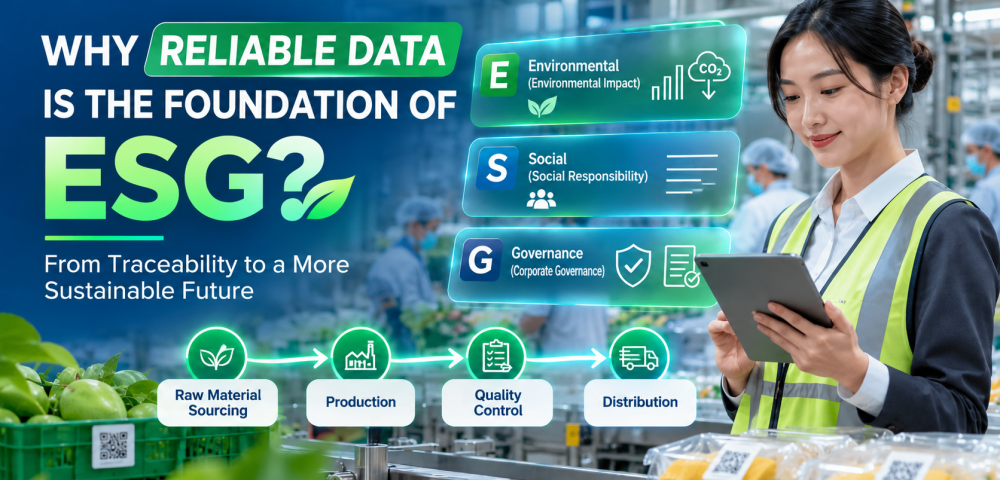
As sustainable development becomes an increasingly important strategic priority, ESG (Environmental, Social, and Governance) is playing a vital role in corporate governance, risk management, and the development of sustainable supply chains.
However, one of the biggest challenges businesses face when implementing ESG is not simply establishing policies or setting sustainability targets. It is also their ability to collect, manage, and verify ESG data.
Businesses may commit to reducing emissions, sourcing materials responsibly, or improving transparency across their supply chains. Yet without accurate data and verifiable evidence, these commitments are difficult to assess objectively.
So, why is reliable data considered the foundation of ESG? And how can product traceability help businesses build a data infrastructure that supports sustainable management?
1. What Is ESG and Why Is It Becoming Increasingly Important for Businesses?
ESG stands for three key pillars:
- Environmental: Evaluates how a business manages its environmental impact, including resource consumption, energy use, emissions, and waste management.
- Social: Focuses on a company’s responsibilities toward its employees, customers, suppliers, and communities.
- Governance: Covers transparency, accountability, risk management, and compliance with relevant regulations.
ESG provides businesses with a structured approach to sustainable development rather than limiting sustainability efforts to isolated corporate social responsibility initiatives.
For businesses in manufacturing, food processing, and export industries, ESG is also closely connected to growing demands for information transparency from customers, business partners, and other supply chain stakeholders.
To meet these expectations, businesses need to establish reliable data systems that enable them to monitor, evaluate, and demonstrate their operational practices.
2. Why Is Reliable Data the Foundation of ESG?
ESG data refers to the information that reflects a company’s activities and performance across environmental, social, and governance dimensions.
An effective ESG data management system should ensure several essential qualities, including accuracy, completeness, consistency, traceability, and verifiability.
2.1. Environmental – Measuring and Managing Environmental Impact
Businesses cannot properly evaluate their environmental performance without reliable data on production activities and resource consumption.
Key information may include:
- The origin and types of raw materials used.
- Electricity, water, and energy consumption.
- Greenhouse gas emissions data.
- The amount of waste generated during production.
- Resource management and utilization activities.
Systematically recording this information enables businesses to identify resource-intensive production stages, monitor changes over time, and evaluate the effectiveness of environmental improvement initiatives.
For example, an agricultural processing company can combine raw material origin data, production output, and energy consumption records to analyze operational efficiency at each production stage.
However, product traceability data represents only one part of a broader environmental information system. Assessing emissions and environmental impacts still requires appropriate measurement and calculation methodologies.
2.2. Social – Strengthening Social Responsibility Across the Supply Chain
Corporate social responsibility extends beyond a company’s internal operations. It also involves suppliers, business partners, and other entities participating in the supply chain.
To manage these aspects, businesses need to collect and monitor information such as:
- Supplier profiles and identification records.
- Raw material origins and supplier information.
- Supplier certifications and assessment records.
- Working conditions and occupational health and safety information.
- Social responsibility inspection and evaluation records.
Transparent data helps businesses gain a clearer understanding of supply chain participants, identify potential risks, and establish more responsible supplier management practices.
In particular, for businesses working with multiple tiers of suppliers, the ability to connect information across different entities is essential to improving supply chain transparency.
2.3. Governance – Improving Transparency and Accountability
Effective corporate governance relies on accurate, consistent, and verifiable information.
In practice, however, business data is often stored across multiple departments or managed through separate spreadsheets and independent systems.
This can lead to several challenges:
- Duplicated or inconsistent data.
- Difficulties identifying the origin of information.
- Time-consuming reporting and data consolidation processes.
- Insufficient documentation for audits and cross-checking.
- Challenges in managing data access permissions and tracking changes.
Standardizing data recording procedures, establishing access controls, and maintaining data histories can help businesses strengthen their internal controls.
At the same time, verifiable data provides a foundation for compliance assessments and strengthens accountability toward stakeholders.
3. Key Challenges Businesses Face When Managing ESG Data
Although awareness of ESG continues to grow, many businesses still face difficulties establishing effective data systems to support sustainable management.
3.1. Data Is Fragmented Across Multiple Departments
Raw material information may be managed by the procurement department, production data may be stored at manufacturing facilities, while quality records are maintained separately by the QA/QC department.
When businesses need to consolidate information for ESG assessments, they must collect data from multiple sources.
This process can be time-consuming and increase the risk of information inconsistencies.
3.2. Limited Data Connectivity Across the Supply Chain
A product may pass through multiple stages, from raw material sourcing and manufacturing to packaging and distribution.
If data from each stage is not properly connected, businesses may struggle to obtain a complete product history or trace information back to its original suppliers.
3.3. Difficulties Verifying Data Accuracy
Manually recorded data or information collected without proper control procedures can reduce overall data reliability.
For ESG management, simply having data is not enough. Businesses also need to understand where the data comes from, who is responsible for recording it, and what supporting evidence is available to verify its accuracy.
This is why digitalization and data management solutions are becoming increasingly important in supply chain operations.
4. How Does Product Traceability Help Businesses Build ESG Data?
Product Traceability refers to the ability to track and trace the history, location, or movement of products and their related components through recorded information.
In ESG management, product traceability can help businesses establish a more transparent data foundation, particularly for activities involving raw materials, production processes, and supply chain operations.
4.1. Digitizing Information from Raw Materials to Finished Products
Instead of managing information through disconnected records, businesses can digitize data at every stage of the production process, including:
Incoming Raw Materials → Production → Quality Control → Packaging → Distribution
Relevant information may include batch codes, supplier details, production dates, quality inspection results, and distribution records.
Recording data in a standardized structure makes information easier to manage, access, and retrieve when needed.
4.2. Improving Data Transparency and Verifiability
When data is linked to individual products or batches, businesses can retrieve relevant information more quickly and efficiently.
This supports internal audits, supplier evaluations, and the provision of supporting documentation to business partners when required.
However, traceability alone does not automatically guarantee that all recorded information is accurate. Businesses still need appropriate verification procedures, quality control measures, and access management policies.
4.3. Supporting Sustainable Supply Chain Management
An effective product traceability system can help businesses:
- Improve visibility into raw material origins.
- Enhance data consistency across different production stages.
- Support supplier assessment and management.
- Reduce the time required to retrieve information during inspections and audits.
- Build a data foundation that supports certain ESG assessment activities.
Through these capabilities, product traceability becomes an important component in helping businesses move from fragmented information management toward more systematic supply chain data management.
5. TraceVerified – Digitalization and Product Traceability Solutions for Greater Supply Chain Data Transparency
To implement ESG effectively, businesses need to start by building a data foundation that enables information to be recorded, managed, and retrieved consistently.
TraceVerified provides digitalization and product traceability solutions that help businesses enhance transparency across their production activities and supply chain management processes.
Through its product traceability solutions, TraceVerified aims to support businesses in:
- Digitizing Product Data: Recording information related to raw materials, production processes, and finished products.
- Connecting Supply Chain Information: Supporting data management across different operational stages and relevant stakeholders.
- Enhancing Traceability: Enabling businesses to retrieve product histories and origin information when needed.
- Supporting Transparent Management: Establishing a data foundation for monitoring, cross-checking, and providing information to relevant stakeholders.
Although product traceability does not replace an entire ESG management system, building structured and traceable product data is an important step toward improving supply chain transparency.
6. Conclusion: Effective ESG Starts with Reliable Data
ESG is not simply about establishing environmental, social, and governance commitments. It is also about having the ability to measure, monitor, and demonstrate those commitments through reliable information.
When data is properly recorded, consistently managed, and verifiable, businesses are better equipped to assess risks, improve operational efficiency, and meet the transparency expectations of stakeholders.
Product traceability is one of the solutions that can help businesses gradually establish a transparent data foundation and support more sustainable supply chain management.
Is Your Business Ready to Improve Supply Chain Data Transparency?
Discover how TraceVerified can help your business digitize product information, enhance traceability, and build a reliable data foundation to support sustainable management.
Explore our solutions and get in touch with TraceVerified:
https://www.traceverified.com/
Frequently Asked Questions About ESG Data (FAQ)
What Is ESG?
ESG stands for Environmental, Social, and Governance. It is a framework used to evaluate a company’s activities and risks related to sustainable development.
Why Does ESG Data Need to Be Verifiable?
Verifiable data enables businesses to provide supporting evidence for their reported information, reduce the risk of inaccuracies, and strengthen transparency throughout the ESG assessment process.
Is Product Traceability Part of ESG?
Product traceability is not an independent ESG pillar. However, it is a tool that supports the management and transparency of data related to raw material origins, suppliers, production processes, and supply chains.
Do Businesses Need to Implement Product Traceability to Achieve ESG Goals?
Not every business is required to implement a dedicated product traceability system to pursue ESG objectives. However, for industries with complex supply chains, such as agriculture, food processing, and manufacturing, product traceability can play an important role in managing and verifying relevant information.