


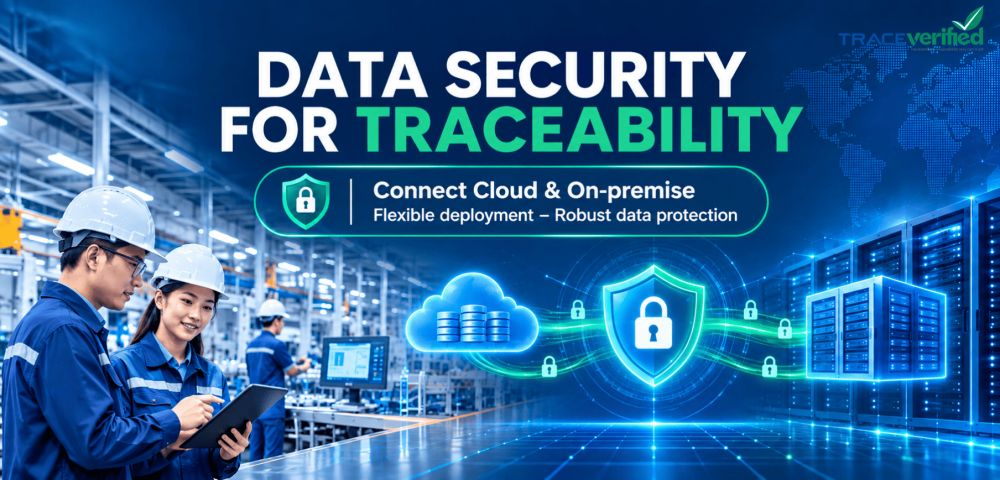
Connecting internal systems to an external platform to support product traceability is not merely a technology integration challenge. It also raises important information security considerations. For manufacturing companies, particularly those operating complex IT environments, sharing data with third parties can raise several concerns: Which data can be exchanged? Could internal systems be affected? Who has control over the connection and hosting infrastructure?
How can businesses meet their product traceability requirements while maintaining existing security standards and IT governance principles?
1. Hybrid Infrastructure – Security Challenges in a Hybrid Environment
In manufacturing environments, data may be stored across multiple platforms, ranging from cloud environments and ERP systems to physical servers managed internally (on-premise). Each environment has its own requirements for permissions, connectivity, and access control.
When implementing a product traceability solution, businesses must ensure not only that data can be connected but also that information is exchanged in a way that complies with their existing security policies.
This is the challenge that TraceVerified aims to address through flexible deployment approaches, enabling businesses to connect data for product traceability while taking their internal IT infrastructure governance requirements into account.
Large-scale manufacturing companies rarely store all their data on a single platform. Instead, they typically operate a hybrid infrastructure that combines cloud environments with internally managed on-premise servers.
Each environment serves a different purpose:
- Cloud Infrastructure: Provides scalable resources, operational flexibility, and access to data from multiple locations.
- On-premise Infrastructure: Allows businesses to maintain direct control over servers, databases, and internal access control policies.
- Hybrid Infrastructure: Combines both models to meet business requirements for operations, data storage, and enterprise data management.
However, when implementing product traceability, connecting data across these environments to an external platform can introduce several security challenges.
Key considerations include:
- Data Exposure: The risk of exposing internal data when exchanging information with external systems.
- Unauthorized Access: The risk of unauthorized access if permissions and authentication mechanisms are not properly configured.
- Network Security: The need to control connections between internal systems and external platforms.
- Data Governance: Ensuring that data is shared within the appropriate scope, purpose, and authorization framework.
- Infrastructure Compatibility: Ensuring that the traceability solution is compatible with the company’s existing IT architecture.
For businesses with strict information security requirements, implementing a new platform cannot be based on convenience alone. Any solution must be evaluated in terms of its compatibility with the organization’s existing system architecture and information security policies.
2. Security vs. Convenience – Balancing Data Connectivity and Security Control
One of the main challenges in implementing product traceability is connecting data without making unnecessary changes to the existing IT environment.
If all data is transferred to an external platform, businesses may face additional requirements for storage management, access permissions, and information flow control.
On the other hand, overly restrictive security policies can make data connectivity and exchange between systems more complicated.
Therefore, businesses should establish several key principles before implementation.
2.1. Data Access Control – Managing Data Access Permissions
Not all internal data needs to be shared with a product traceability platform.
Businesses should identify which data fields can be exchanged, who is authorized to access them, and which categories of information must remain protected.
2.2. Secure Data Transmission – Protecting Data in Transit
Data exchange between internal systems and external platforms requires careful consideration of connection methods, authentication mechanisms, and information protection protocols.
Technologies and policies such as HTTPS/TLS, VPNs, proxies, and firewalls can play an important role in establishing connections that meet the requirements of the IT department.
2.3. Infrastructure Compatibility – Integrating with Existing Infrastructure
A product traceability solution should be evaluated based on the architecture of the systems currently operated by the business.
This is particularly important for organizations that use a combination of cloud environments, internal servers, and specialized enterprise management software.
2.4. IT Governance – Maintaining IT Governance Principles
The IT department should be able to assess and control deployment methods, connection configurations, and related operational requirements.
Choosing an appropriate deployment approach helps businesses minimize unnecessary changes to their existing infrastructure.
3. Flexible Deployment – Adapting to Enterprise IT Architecture
Every business has its own infrastructure model and security policies. Therefore, a product traceability solution should be evaluated based on actual operating conditions rather than relying on a single deployment model.
With a focus on providing enterprise traceability solutions and data connectivity, TraceVerified aims to offer flexible deployment approaches that accommodate different infrastructure environments.
Two deployment options can be considered:
3.1. Cloud Deployment – Deployment on Cloud Infrastructure
For businesses already operating on cloud platforms, cloud deployment can simplify certain aspects of server and infrastructure resource management.
Under the proposed model, the TraceVerified solution can be deployed and managed on cloud infrastructure operated by a service provider, such as AWS.
This approach aims to:
- Reduce the need to invest in and manage dedicated physical servers.
- Leverage cloud infrastructure for solution deployment and operation.
- Support resource scalability based on business requirements.
- Simplify certain infrastructure management tasks for the enterprise.
However, businesses should still evaluate factors such as data storage locations, access permissions, backup mechanisms, and the service provider’s security policies before deployment.
3.2. On-premise Deployment – Deployment on Enterprise-managed Servers
For businesses with strict infrastructure control requirements, deploying directly on internally managed servers (on-premise) may be an option worth considering.
Under this approach, the solution is installed within a server environment managed by the business, rather than relying entirely on external cloud infrastructure.
This approach can help businesses:
- Manage server resources such as CPU and RAM directly.
- Control storage environments and databases.
- Configure firewall policies in accordance with internal requirements.
- Review and configure appropriate outbound connections.
- Apply connection mechanisms such as HTTPS/TLS, VPNs, or proxies based on the existing network architecture.
- Maintain the IT department’s internal deployment review and approval processes.
In particular, on-premise deployment gives businesses greater flexibility in evaluating and managing their deployment environment. However, the actual level of control depends on the deployment scope, administrative permissions, and operational responsibilities agreed upon by both parties.
4. TraceVerified – Connecting Traceability Data While Addressing Enterprise Security Requirements
For manufacturing businesses, implementing product traceability should not create an isolated operational system or require a complete overhaul of the existing IT architecture.
Instead, a solution should be evaluated based on its ability to integrate with existing systems while addressing enterprise data management and information security requirements.
With a focus on providing enterprise traceability solutions, TraceVerified addresses the challenge of connecting and managing data throughout the supply chain.
During implementation, several important factors should be considered:
4.1. Integration Flexibility – Flexible System Integration
The ability to connect with existing enterprise management systems such as ERP, WMS, and MES is an important consideration when implementing product traceability.
Leveraging data from systems already in operation helps businesses reduce duplicate data entry and minimize the need to change existing management processes.
4.2. Deployment Flexibility – Flexible Deployment Options
Depending on their infrastructure architecture and IT policies, businesses can evaluate cloud or on-premise deployment options that best suit their operational requirements.
This allows solution deployment to be adapted to the actual conditions and requirements of each organization.
4.3. Data Governance – Controlled Data Management
Beyond connectivity, businesses need to clearly define the scope of shared data, access permissions, and information management responsibilities among the parties involved.
These principles provide an important foundation for maintaining consistency in data governance and minimizing risks associated with information exchange with external systems.
Through this approach, TraceVerified aims to help businesses implement product traceability without overlooking security, governance, and IT system continuity requirements.
5. Conclusion – Product Traceability Does Not Mean Compromising Security
For manufacturing businesses, implementing product traceability is not simply about connecting data across systems. It also involves maintaining control over information and protecting existing technology infrastructure.
An appropriate solution should balance three key factors: integration capabilities, deployment flexibility, and enterprise information security requirements.
Rather than forcing businesses to choose between convenience and security, evaluating suitable connectivity and deployment options can help ensure that product traceability implementation better aligns with actual operational needs.
TraceVerified aims to provide flexible product traceability solutions that support businesses in connecting data and managing supply chain information while taking their existing IT architecture into account.
Learn more about TraceVerified’s product traceability and data integration solutions: Contact TraceVerified.