


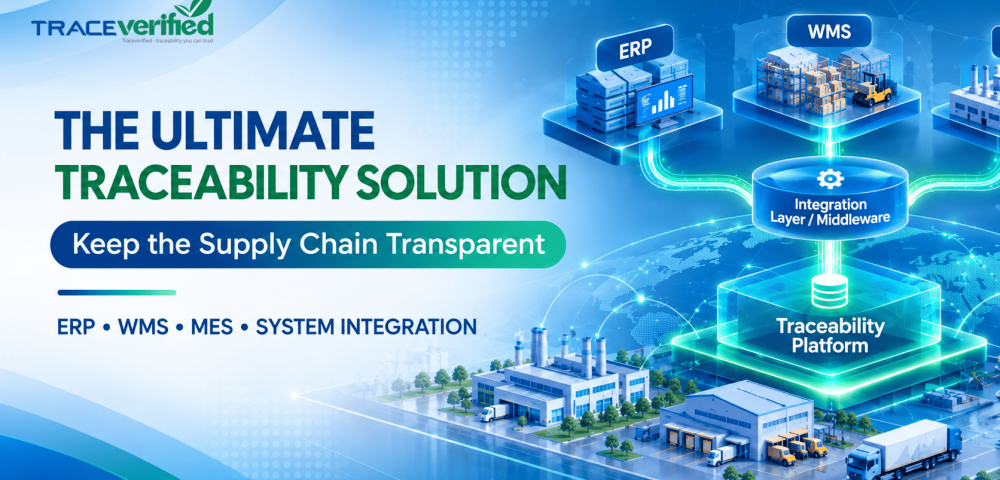
When implementing a product traceability system, one of the biggest challenges facing manufacturers, importers, and distributors is not the creation of QR codes or the development of a new management platform. The more complex issue is the ability to connect and synchronize data across the technology systems already in operation.
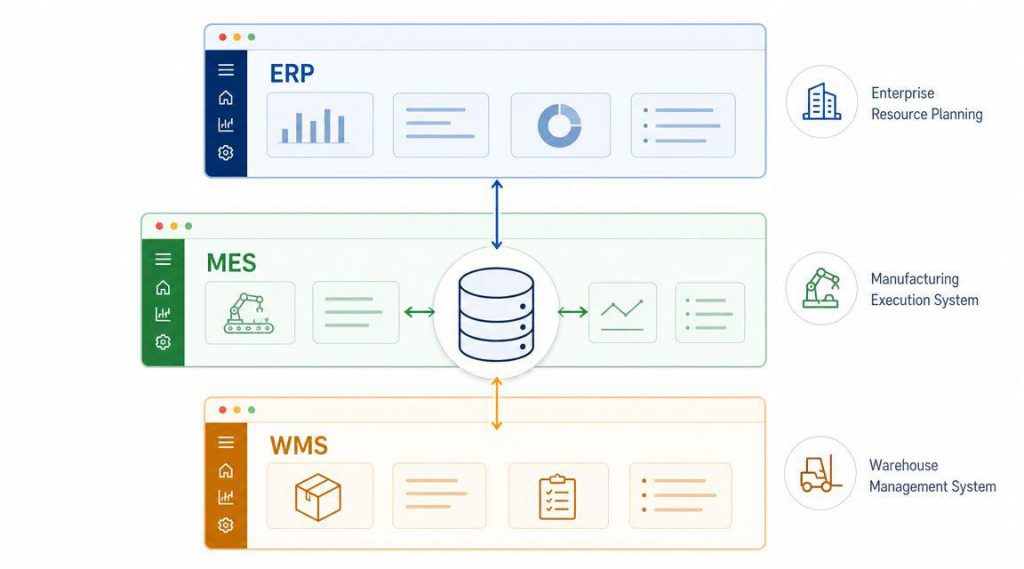
In practice, many businesses have made significant investments in ERP (Enterprise Resource Planning), WMS (Warehouse Management System), and MES (Manufacturing Execution System) platforms to manage business operations, warehousing and logistics, and production. However, these systems are often implemented at different times and use their own data structures and information exchange methods.
When a business needs to implement traceability and connect data to external platforms, it faces an important question: How can data be connected, standardized, and synchronized without replacing the entire existing IT infrastructure?
The answer lies in a System Integration strategy, combined with data standardization and a flexible connectivity architecture.
Rather than replacing systems that are already operating reliably, businesses can leverage their existing technology infrastructure to build an interconnected data ecosystem that supports management and end-to-end traceability across the supply chain.
1. Why Does Existing IT Infrastructure Become a Barrier to Traceability Implementation?
At many medium-sized and large enterprises, product data is not managed centrally on a single platform. Instead, information is distributed across multiple systems serving different operational functions.
A product may be managed under an SKU code in the ERP, recorded under a production lot in the MES, and tracked through inbound and outbound warehouse movements in the WMS.
Although these systems all support business management, they are not always capable of exchanging data directly with one another.
1.1. Data Silos – Data Fragmentation Across Systems
Data silos occur when data is stored and managed in independent systems, making information difficult to share or use consistently.
In a manufacturing business, this situation may arise when:
- ERP manages product information, SKU codes, suppliers, and orders.
- MES records incoming raw materials, production batches, and manufacturing stages.
- WMS manages goods receipt, dispatch, inventory, and the movement of goods.
- QMS stores quality inspection results and testing records.
- CRM manages customers, distributors, and commercial activities.
When building traceability records, a business must connect these datasets to create a continuous information chain from incoming raw materials to finished products and distribution.
If the systems are not integrated, information may have to be reconciled manually using Excel, CSV files, or separate reports.
This not only increases workloads but also creates the risk of errors, duplication, and inconsistencies in traceability data.
1.2. System Incompatibility – Incompatibility Between Systems
One of the reasons data integration becomes complex is the difference in technology architectures and data formats.
For example, an ERP system may support REST APIs, while an MES uses an internal database or a proprietary connectivity protocol. Some legacy warehouse management software may not even have been designed to share data with external platforms.
Incompatibility can occur at several levels:
- Differences in data exchange protocols.
- Differences in database structures.
- Differences in product identification methods.
- Differences in date formats and units of measurement.
- Differences in authentication and access-control procedures.
Therefore, connecting data for traceability is not simply a matter of establishing a communication channel between two software applications. Businesses must also ensure that data is interpreted correctly and used consistently in both the source and destination systems.
1.3. Integration Complexity – Integration Costs and Complexity
When existing IT systems do not support connectivity out of the box, businesses may need to invest in API development, middleware, or adjustments to their data structures.
Direct modifications to core systems may also involve several risks:
- Disruption to otherwise stable operations.
- Additional development and maintenance costs.
- Greater dependence on software vendors.
- Longer implementation timelines.
- Difficulty expanding integrations to new factories or partners.
For FDI enterprises or businesses operating multiple factories across different countries, integration becomes even more complex because of differences in technology systems, data standards, and operating procedures.
Instead of starting by replacing the entire IT infrastructure, businesses should assess connectivity options and determine how to leverage data from their existing systems.
2. Can Traceability Data Be Connected Without Replacing ERP, WMS, and MES?
Yes.
Businesses can implement traceability on top of their existing technology infrastructure through System Integration solutions, rather than replacing all the software they currently use.
One common approach is to build an intermediate data connectivity layer, also known as an Integration Layer or Middleware.
Instead of allowing the traceability platform to access each core system directly, this intermediate layer receives, processes, standardizes, and distributes data between systems.
2.1. Middleware – The Intermediate Data Connectivity Layer
Middleware is software that enables systems with different architectures and protocols to exchange data.
In product traceability, middleware can perform the following functions:
- Collect data from ERP, WMS, MES, and related systems.
- Convert data from source formats into a unified structure.
- Match product codes, batch codes, supplier codes, and identification information.
- Validate data completeness and accuracy before synchronization.
- Forward data to the traceability platform or other destination systems.
- Record data exchange histories and synchronization status.
For example, the ERP may use product code SKU-001, the MES may use finished-goods code FG-001, and the WMS may use internal item code WH-001.
Through Data Mapping, middleware can link these codes to the same product entity in the traceability system.
As a result, businesses do not necessarily need to change the data structures of each system at the outset.
2.2. API Integration – Connecting Systems Through APIs
An API (Application Programming Interface) is an application programming interface that allows software systems to exchange data and processing requests through predefined interfaces.
It is one of the most common methods for integrating a traceability system with an enterprise IT infrastructure.
Depending on the technology architecture, businesses can choose from several integration methods:
REST API – Connectivity Through HTTP
REST APIs allow systems to exchange data through HTTP requests, commonly using the JSON format.
This method is suitable for ERP, WMS, or MES platforms that support APIs and need to exchange information with external applications.
Webhook – Event-Driven Data Synchronization
A webhook allows one system to automatically send a notification or data to another system when a specific event is triggered.
For example, when a shipment is confirmed as dispatched in the WMS, the system can send the corresponding information to the traceability platform without waiting for the next scheduled synchronization cycle.
SOAP API – Connecting with Traditional Enterprise Systems
SOAP is an XML-based messaging protocol commonly used in some enterprise systems with traditional integration architectures.
It may be a suitable option when a business uses legacy platforms that support SOAP.
Database Integration – Connectivity Through Databases
In some cases, data can be exchanged through authorized database access or controlled data synchronization methods.
This approach must be carefully designed to avoid affecting the performance and integrity of core systems.
File-Based Integration – Data Exchange Through Files
For systems that do not support APIs, businesses can exchange data on a schedule using formats such as CSV, XML, or JSON.
This may be an option when integrating legacy systems or platforms that cannot connect directly.
There is no single integration method that suits every business. The choice should be based on technical capabilities, security requirements, update frequency, and the operational characteristics of each system.
2.3. Data Mapping & Data Transformation – Standardizing Data Across Systems
A technically successful connection does not automatically mean that the data is usable.
This is one of the key issues in system integration projects.
For example, the same production-date information may be recorded in different formats across systems:
- ERP: 2026-11-13.
- MES: 13/11/2026.
- WMS: 13-Nov-2026.
In addition to date formats, systems may differ in field names, units of measurement, product identification rules, and status definitions.
Businesses therefore need Data Mapping, a mechanism for mapping data between source and destination systems.
This process includes:
- Identifying corresponding data fields across systems.
- Standardizing information formats.
- Establishing rules for matching product codes and batch codes.
- Checking data completeness and validity.
- Handling duplicate or inconsistent data.
Data Mapping ensures that information is interpreted consistently across systems, reduces synchronization errors, and supports data reconciliation throughout the supply chain.
3. How Does a Traceability Data Integration Architecture Work?
To understand how traceability data can be connected without replacing existing IT systems, consider a food manufacturing and distribution business that operates separate ERP, MES, and WMS platforms.
The business wants to implement a traceability platform to manage information from incoming raw materials and production through to warehousing and distribution.
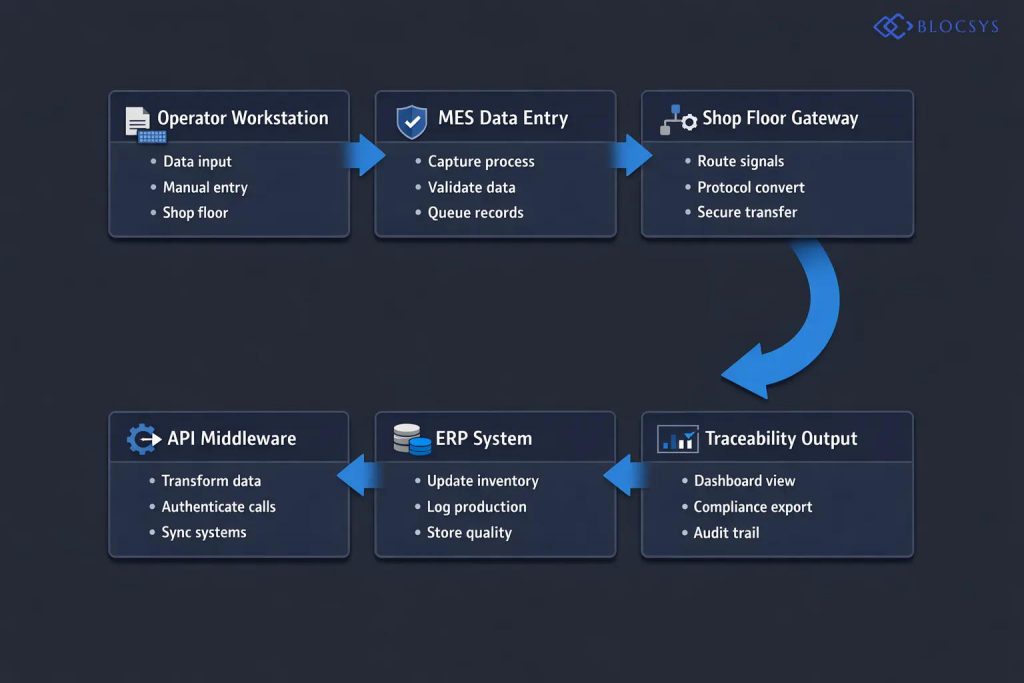
In this case, a reference data integration architecture can be organized into five main layers.
3.1. Data Sources – The Data Source Layer
This layer brings together data from the management systems currently used by the business.
Common data sources include:
- ERP: Product information, SKU codes, suppliers, orders, and transactions.
- MES: Raw materials, production batches, manufacturing stages, and operational results.
- WMS: Goods receipt, dispatch, inventory, and goods movement information.
- QMS: Quality inspection results, testing records, and approval status.
- Procurement: Supplier information, raw material sources, and purchasing activities.
The objective of this layer is to identify what data exists, where it is managed, and which system is responsible for creating or updating it.
3.2. Integration Layer – The Data Integration Layer
The Integration Layer receives data from source systems through appropriate connectivity methods.
Depending on the IT infrastructure, businesses may use REST APIs, SOAP APIs, webhooks, database integration, or file-based integration.
The integration layer reduces dependence on direct connections between every individual system while establishing a centralized and controlled data exchange mechanism.
3.3. Data Processing – The Data Processing and Standardization Layer
After data is received, it must be processed before being transferred to the traceability platform.
Key activities include:
- Data Mapping: Mapping data fields between source and destination systems.
- Data Transformation: Converting data into a standardized format.
- Data Validation: Checking completeness and validity.
- Data Deduplication: Detecting and handling duplicate records.
- Data Reconciliation: Reconciling information across data sources.
This layer is particularly important because a system may connect successfully while still failing to ensure data accuracy if standardization and validation mechanisms are missing.
3.4. Traceability Platform – The Traceability Platform Layer
After processing, data is linked within the traceability platform to create product records and operational histories.
Depending on the business model, the system may manage:
- Product identification information.
- Manufacturer and supplier information.
- Raw material origins.
- Production batch/lot numbers.
- Manufacturing dates and expiry dates.
- Manufacturing stages.
- Goods receipt, dispatch, and distribution activities.
- Events related to transportation.
The key is to link data by product, batch, and supply chain events, rather than simply collecting isolated information fields.
3.5. Data Exchange – The Data Exchange Layer
This layer supports data sharing with external systems and partners.
Recipients may include:
- Government management systems that provide the relevant connectivity interfaces.
- Distributors and logistics partners.
- Manufacturers and suppliers.
- Supply chain management platforms.
- Traceability systems operated by relevant partners.
Connections must comply with the technical specifications, data formats, authentication mechanisms, and security requirements of each receiving system.
With this architecture, the traceability platform adds capabilities for data management and connectivity rather than replacing the functions of the entire ERP, MES, or WMS environment.
4. Standards and Technologies to Consider When Integrating Traceability Data
In addition to connectivity architecture, businesses should consider identification standards and data structures to ensure information can be exchanged across different systems.
For businesses involved in manufacturing, importing, and distribution across multiple countries, adopting widely used data standards can help reduce differences between systems and supply chain partners.
4.1. GS1 Standards – Identification Standards for the Supply Chain
GS1 is an organization that develops international standards for identification, data capture, and data sharing across supply chains. GS1 standards are used in many sectors, including retail, manufacturing, logistics, food, and pharmaceuticals.
Some important components for businesses to understand include:
GTIN (Global Trade Item Number)
A global trade item number used to identify a product or trade item.
GTIN helps businesses manage and reconcile product information across systems, manufacturers, and trading partners.
GLN (Global Location Number)
A global location number that helps identify organizations, locations, or departments within a supply chain.
For example, a business can use GLNs to identify manufacturing plants, warehouses, or distribution locations.
SSCC (Serial Shipping Container Code)
A logistics unit identifier used to identify shipping units such as pallets or packages.
SSCC supports the tracking of goods as they move between locations in the supply chain.
GS1 Digital Link
A standard that connects GS1 identifiers to online information sources, allowing users and systems to access product information through compatible carriers such as QR codes.
It is important to note that a GTIN identifies a trade item type; it does not automatically provide the full production or distribution history. Businesses still need to build the corresponding system for recording and linking traceability data.
4.2. EPCIS – Standardizing Traceability Event Data
EPCIS (Electronic Product Code Information Services) is a GS1 standard that supports the sharing of information about events occurring across the supply chain.
EPCIS helps businesses describe and exchange data about the movement of products between relevant parties.
Rather than managing only static product information, EPCIS focuses on traceability events through five key questions:
- What: What object was observed?
- When: When did the event take place?
- Where: Where did the event take place?
- Why: Why did the event occur?
- How: How was the event carried out?
For example, in a food supply chain:
- The factory records the completion of a production batch.
- The warehouse team confirms that the batch has been received into inventory.
- The logistics provider records the transportation process.
- The distributor confirms receipt of the goods.
These events can be recorded and exchanged using an appropriate EPCIS structure.
EPCIS is particularly useful when a business needs end-to-end supply chain traceability, information sharing with multiple partners, or data connectivity across different systems.
4.3. API Security & Data Governance – Data Security and Governance
An effective integrated system must not only exchange data quickly; it must also ensure data integrity, controllability, and information security.
Businesses should consider the following factors:
- Authentication & Authorization – Authentication and access control: Verify the identities of systems and users authorized to access data.
- Data Encryption – Data encryption: Protect data during transmission and storage in accordance with security requirements.
- Data Validation – Data validation: Ensure submitted data complies with defined rules and structures.
- Audit Logs – Activity logs: Record access, exchange, and modification histories to support audits and reconciliation when needed.
- Error Handling – Error management: Establish mechanisms to detect and handle errors and resynchronize data when connections are interrupted.
- Data Governance – Data governance: Define data ownership, update responsibilities, and data management procedures across departments and partners.
In particular, when data is exchanged among multiple businesses and international partners, it is necessary to clearly define which party is responsible for creating, validating, and updating each category of information.
This provides the foundation for ensuring traceability data can be verified and reconciled, rather than merely being aggregated from multiple sources.
5. Implementation Roadmap for Traceability Data Integration
Rather than implementing integration across all systems at once, businesses can take a phased approach to control costs, risks, and investment outcomes.
5.1. System Assessment – Assessing the Existing IT Environment
First, businesses should review their entire technology infrastructure to determine its ability to connect and exchange data.
Areas to assess include:
- Which systems does the business currently use: ERP, WMS, MES, QMS, or CRM?
- Which systems support APIs?
- Can the systems export data in CSV, XML, or JSON formats?
- Is product data managed centrally or across multiple systems?
- Are there differences in product codes, batch codes, and supplier codes?
- Which data needs to be shared with the traceability platform?
The outcome of this phase is an assessment of the existing systems, identifying bottlenecks and defining the scope of integration.
5.2. Data Gap Assessment – Assessing Data Gaps
After identifying the data sources, businesses need to analyze the completeness and consistency of the information.
For example:
- ERP: Check product codes, SKUs, supplier information, and trade item information.
- MES: Check production batch codes, incoming raw materials, and process-stage data.
- WMS: Check goods receipt, dispatch, and goods movement information.
- QMS: Check testing records and quality control results.
- Procurement: Check supplier information and raw material sources.
Based on this assessment, businesses can identify:
- Missing information fields.
- Duplicate data fields.
- Identifiers that cannot yet be matched.
- Information inconsistencies between source and destination systems.
- Data that needs to be added or standardized.
The objective is to establish a suitable data structure before integration begins.
5.3. Integration Design – Designing the Integration Architecture
Based on the assessment results, the technical team selects connectivity methods and designs the integration architecture.
Key decisions include:
- Should APIs or middleware be used?
- Which system will serve as the primary data source?
- Should data be synchronized in real time or on a schedule?
- How should error handling and resynchronization be designed?
- Which security and access-control requirements should be applied?
Not every system needs real-time integration.
For some data categories, scheduled synchronization may be sufficient to meet management needs.
By contrast, important events such as production completion, goods dispatch, or handover may require faster updates.
5.4. Pilot Implementation – Pilot Deployment
Businesses should first select a group of SKUs, one factory, or a specific process for testing before rolling out the solution more broadly.
During this phase, the following should be checked:
- Is data synchronized completely?
- Are product codes and batch codes matched accurately?
- Does duplicate data occur?
- Can the system resynchronize data when a connection is interrupted?
- Can traceability data be verified across all stages?
- Are actual operating processes affected?
The pilot results provide a basis for adjusting the architecture and finalizing the implementation approach.
5.5. System Integration – Expanding System Connectivity
Once the pilot meets the required criteria, businesses can expand connectivity to other factories, warehouses, and partners.
Expansion should be carried out by system group or process to maintain control.
For businesses with multinational supply chains, particular attention should be paid to data connectivity among suppliers, factories, and distributors across different countries.
5.6. Monitoring & Optimization – System Monitoring and Optimization
System integration does not end once the platforms have been successfully connected.
Businesses need to maintain monitoring mechanisms to:
- Detect data synchronization errors.
- Monitor connectivity between systems.
- Check information consistency.
- Manage changes to data structures.
- Evaluate performance and scalability.
- Ensure data is updated according to agreed procedures.
This step is essential to maintaining the stability of the traceability system and ensuring that it meets long-term operational needs.
6. Challenges Businesses Should Consider When Integrating Traceability Systems
Although System Integration allows businesses to leverage their existing IT infrastructure, implementation may still involve technical, data-related, and operational governance challenges.
6.1. Legacy Systems – Older Technology Systems
Some businesses still use ERP, MES, or WMS software developed many years ago.
These systems may not support modern APIs, may lack complete technical documentation, or may depend on the original software vendor.
In such cases, businesses should assess connectivity through adapters, middleware, or intermediate data exchange mechanisms, rather than assuming that all software must be replaced.
6.2. Data Quality – Inconsistent Data Quality
This is one of the common reasons why integration projects fail to deliver the expected results.
Even when systems have been successfully connected, data may still be incomplete or inaccurate because of:
- Inconsistent product codes.
- Outdated supplier information.
- Missing raw material origin data.
- Batch codes that are not linked between production and warehousing/logistics.
- Manually entered data without a validation process.
Businesses should therefore address Data Quality before and throughout integration to ensure the reliability of traceability information.
6.3. Scalability – System Scalability
An integration architecture may work well when connecting only one factory or one product group, but may not necessarily meet requirements when the business expands to thousands of SKUs, multiple factories, and hundreds of partners.
For this reason, scalability should be considered from the outset in terms of the number of systems, data volume, exchange frequency, and number of users.
Multinational businesses, in particular, need a sufficiently flexible architecture to receive data from different systems and formats.
6.4. Data Security – Data Security and Access Rights
Production data, supplier information, product formulas, and business activities may contain sensitive corporate information.
Connections to external platforms must be designed around access permissions, access controls, and data protection.
Businesses need to define which data can be shared, which parties are authorized to access it, and the scope of information each partner may use.
This is important for balancing supply chain transparency with the protection of business information.
7. TraceVerified – Integrating Traceability Data with Existing IT Infrastructure
For manufacturers, importers, and distributors, implementing traceability should not begin with replacing the entire technology environment currently in use.
What matters more is assessing how existing data can be leveraged, identifying bottlenecks in information exchange, and developing an integration approach that fits the enterprise IT architecture.
With a focus on traceability solutions and supply chain data management, TraceVerified aims to help businesses connect existing management systems, standardize data, and build a scalable traceability platform.
Consulting and implementation services can focus on four main areas:
7.1. System Assessment – Technology Infrastructure Assessment
Review existing ERP, WMS, MES, and other management platforms to identify:
- The connectivity capabilities of each system.
- Supported data exchange methods.
- Architectural and technical limitations.
- Bottlenecks in data management processes.
This gives businesses a basis for selecting an integration approach that fits their current infrastructure.
7.2. Data Standardization – Data Standardization
Assess data structures, product identifiers, supplier information, and operational data to establish consistent matching mechanisms.
This process aims to reduce fragmented, duplicated, and inconsistent data across systems.
7.3. System Integration – System Integration
Develop an approach for connecting internal systems with the traceability platform through integration methods suited to the existing infrastructure.
The objective is to improve data exchange without creating unnecessary dependence on changes to core systems.
7.4. Traceability Implementation – Traceability Implementation
Support businesses in developing an implementation roadmap based on their supply chain characteristics, product scale, and management requirements.
Gradually connect information about products, manufacturers, raw materials, and operational events to build an interconnected traceability data system.
Through this approach, TraceVerified aims to help businesses make better use of their existing technology investments, minimize operational disruption, and establish a foundation for long-term digital transformation.
8. Frequently Asked Questions About Traceability System Integration (FAQ)
8.1. Do We Need to Replace Our ERP to Implement a Traceability System?
Not necessarily. Businesses can retain their existing ERP system and integrate it with a traceability platform through APIs, middleware, or other data exchange methods.
The choice of approach depends on the connectivity capabilities, data structure, and operational requirements of the existing system.
8.2. Can an ERP System Without API Support Be Connected to a Traceability Platform?
Yes. Alternative options include data exchange through CSV, XML, or JSON files, connectivity through adapters, or scheduled data synchronization.
However, businesses should assess the security, stability, and suitability of each option before implementation.
8.3. What Role Does Middleware Play in a Traceability System?
Middleware acts as an intermediary between technology systems.
It helps collect, convert, standardize, and distribute data between ERP, WMS, MES, and the traceability platform, reducing the need to make direct changes to core systems.
8.4. Can Multiple ERP, WMS, and MES Systems Be Connected at the Same Time?
Yes. Businesses can integrate data from multiple systems into a single traceability platform.
However, they need to establish identification rules, Data Mapping, and data management mechanisms to prevent duplication or inconsistencies.
8.5. Is the Use of GS1 Standards Required for Traceability Data Integration?
The use of GS1 standards depends on the product category, management requirements, and applicable standards.
GTIN, GLN, SSCC, and EPCIS can support identification and supply chain data exchange.
Businesses should distinguish between mandatory legal requirements and standards adopted voluntarily to improve interoperability between systems.
8.6. Does Traceability Data Integration Require Real-Time Synchronization?
Not every data category needs to be synchronized in real time.
For product information or master data, scheduled synchronization may be sufficient.
Meanwhile, important events such as production completion, goods dispatch, or handover may require faster updates.
The choice depends on the business’s operational characteristics and traceability requirements.
8.7. What Factors Affect the Cost of Traceability System Integration?
Integration costs generally depend on:
- The number of systems to be connected.
- The complexity of data structures.
- API support in existing systems.
- The number of SKUs and factories.
- The number of partners in the supply chain.
- Data synchronization frequency requirements.
- Security, storage, and operational requirements.
Businesses should therefore conduct a System Assessment and Data Gap Assessment before determining the implementation budget and scope.
9. Conclusion: Integrate, Don’t Replace – A Practical Approach to Supply Chain Digital Transformation
As businesses increasingly need to manage large volumes of data from multiple sources, the ability to connect and share information has become an important factor in supply chain management.
Implementing traceability does not mean that the entire IT infrastructure must be rebuilt.
Instead, businesses can leverage ERP, WMS, MES, and other existing systems through an appropriate integration architecture.
The key is to build a data ecosystem capable of:
- Connecting fragmented data sources.
- Standardizing product information and identifiers.
- Recording and linking events across the supply chain.
- Ensuring data integrity and traceability for reconciliation.
- Expanding connectivity to external partners and platforms.
Smart integration is not about replacing what a business already has. It is about helping existing systems work more effectively by connecting them.
TraceVerified – Connecting Data and Optimizing Existing IT Infrastructure
Is your business using multiple ERP, WMS, and MES systems but struggling to synchronize traceability data?
TraceVerified is ready to work with your business to assess its existing IT infrastructure, identify data gaps, and recommend an integration approach suited to its operational needs.
Learn more about our solutions:
Website: https://www.traceverified.com/